One of the fastest ways to lose a potential customer is to take too long to reach out. Our website attracts thousands of visitors every day. At rtCamp, we used to spend close to an hour and ten minutes scrolling through visitor logs by hand, roughly 40 hours a month spent hunting instead of talking to prospects. And by the time you find the right prospect, they may already be gone.
So we built an automated system to do that hunting for us, using n8n as the platform behind the entire thing. Here is how it operates, and why it says a lot about how rtCamp approaches AI automation for clients more broadly.
Where it all begins
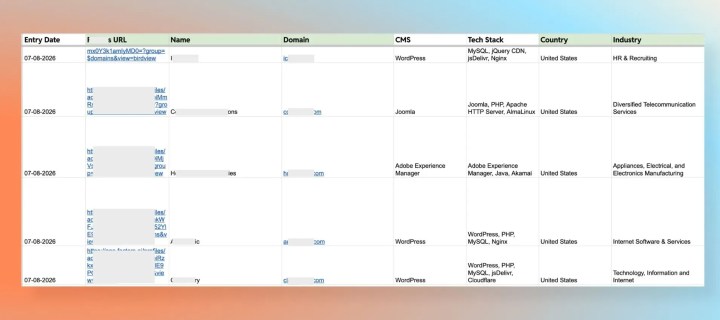
The moment someone visits rtCamp’s website, our visitor tracking platform picks up the basics on its own. It captures the tracking URL, the company name, domain, country, industry, and LinkedIn URL, and passes all of it into a sheet. From there, our n8n powered automation takes over.
The system removes any duplicate entries automatically, so a company visiting more than once in a day only gets processed a single time, saving effort and keeping alerts clean. Once the sheet is ready, the automation sends a message to our marketing Slack channel to let the team know that fresh visitor insights are on the way.
Turning page behavior into real buyer intent
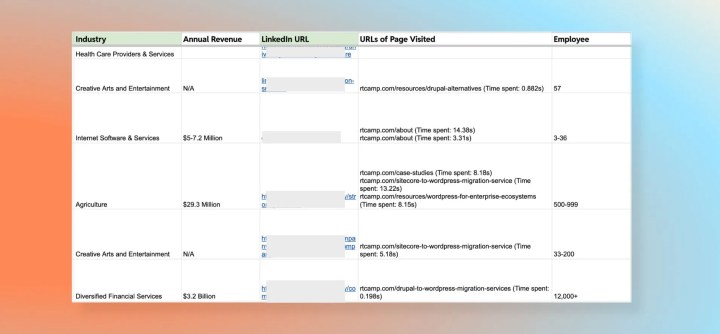
Company names and domains only tell you who showed up. To understand why they showed up, the automation pulls richer engagement details from our tracking software, including total time on site, number of pages visited, the full list of pages, and how deep someone scrolls on each one. Together, these give a much sharper read on what a visitor is actually interested in, rather than a guess based on a single pageview.
From here, the automation identifies the visitor’s CMS, whether that’s WordPress, Drupal, Kentico, or something else, since knowing what a company already runs on shapes what kind of conversation makes sense next. It also brings in Parallel AI, a search tool which is used alongside Gemini, to estimate the company’s revenue and employee count. Together, this gives our team a fuller, more confident picture of who is visiting, well before anyone has looked at a single record.

How the automation scores lead fit
Not every website visit signals buying intent. Based on rtCamp’s own sense of what a valuable visit looks like, every visitor’s journey gets scored as high, medium, or low fit. The scoring looks at which pages someone spends time on, how deep they go into a topic, and whether their overall journey suggests real interest rather than a passing glance.
A visit that includes a contact page along with a couple of other meaningful actions reads as high fit. Someone who works through detailed service or resource pages before reaching out shows a similarly strong pattern. On the other end, a visit limited to something like a careers page, or one that shows very little real engagement, gets marked as low fit, and the process stops there for that record.
This selectivity matters as much as the scoring itself. Running the deeper research stages on a low fit visit uses resources without much return, so the automation is deliberately choosy, only medium and high fit visitors move forward into the next stages.
Spotting bigger, multi-brand opportunities
For visitors that move forward, the automation checks whether the company sits under a larger parent organization and is on WordPress. When it does, this often points to a promising opportunity for OnePress, rtCamp’s framework that helps large, multi-brand enterprises run their many WordPress sites under one shared, well governed structure. Spotting this connection early means our team walks into the conversation already understanding the bigger picture a prospect is operating in.
Matching each prospect to the right solution
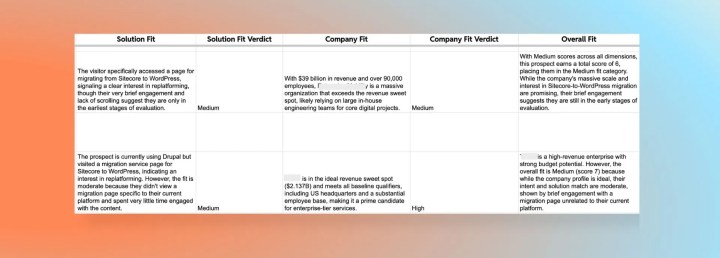
Next, the automation evaluates solution fit: whether what a company is exploring aligns with something rtCamp is genuinely strong at solving. A visitor currently on Drupal who has been reading about moving to WordPress comes through as a strong migration prospect. A visitor already on WordPress, browsing our services pages with proper time spent on the page, comes through as a strong scaling prospect. These categories exist because they map directly to conversations our team can actually have, rather than generic outreach based on a single visit.
Filtering for company fit
Alongside behavior, the automation also checks whether the company fits rtCamp’s ideal customer profile (ICP). It considers factors such as company size, industry, and location. Every company gets scored as low, medium, or high on company fit based on this broader picture, without anyone needing to sit down and check each one by hand.
Bringing it together for overall fit
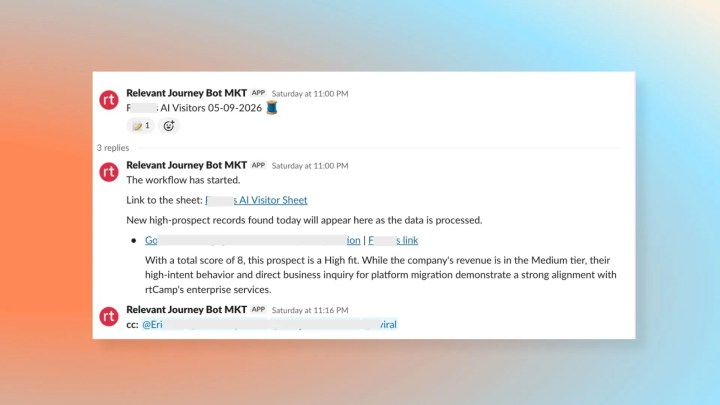
The final stage brings together all three pillars, journey fit, solution fit, and company fit. Only when a company scores strongly across all three does the system mark it as an overall high fit prospect. At that point, it posts a message in Slack tagging the relevant point of contact directly, so our account executives and marketing team see a ready-made signal instead of a raw data dump.
That’s the value of the system in one sentence. Instead of a person checking a portal every day trying to spot a needle in a haystack, the needle gets delivered to them.
Why this matters beyond our own marketing team
We built this system to solve our own bottleneck, and n8n is the platform that made it possible, letting us connect our tracking tool, a spreadsheet, AI models and Slack into one continuous process.
The AI model was only one piece. For the most part, it was breaking down a process our team already knew inside out into a set of steps the system could execute on its own, at a speed humans could barely match.
This is the kind of work rtCamp excels at, helping teams turn processes they already understand into automated systems that are easier to manage. If your team is looking to bring AI automation into how you work, whatever that process happens to look like, get in touch with us and we will help you figure out where to start.
Where it all begins
Turning page behavior into real buyer intent
How the automation scores lead fit
Spotting bigger, multi-brand opportunities
Matching each prospect to the right solution
Filtering for company fit
Bringing it together for overall fit
Why this matters beyond our own marketing team
On this page
Credits

Rishit Gupta
Author
Rishit Gupta
Author
Rishit works as a Growth Engineer at rtCamp. He uses his engineering skills to help build solutions for marketing and sales teams to work more efficiently. He has over 3 years of experience as a fu…
Related articles
-
How rtCamp saves 100 hours of teams using AI powered Sales Qualification
Learnings
-
Behind the table Takeaways from WordCamp’s “Core AI Prompt Bar” with David Levine
Events
Comments
Leave a Reply Cancel reply
Name*
Email*
Comment*
Submit
Δ