TL;DR rtCamp’s AI automation practice built a system that reads new sales leads, qualifies them automatically, and researches every genuine prospect before the sales team ever opens a new tab. The workflow combines a mix of AI models, each matched to a specific task, with a small set of research and enrichment tools. The result: an estimated 100 hours of manual work saved every month.
The problem: A noisy channel full of sales leads
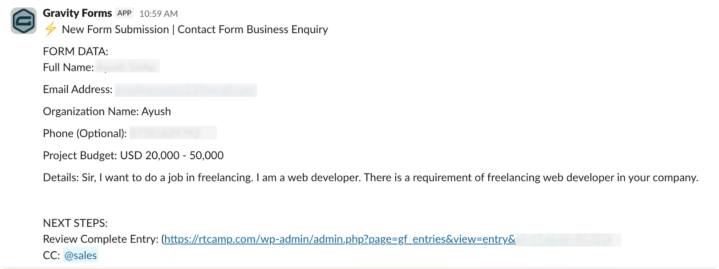
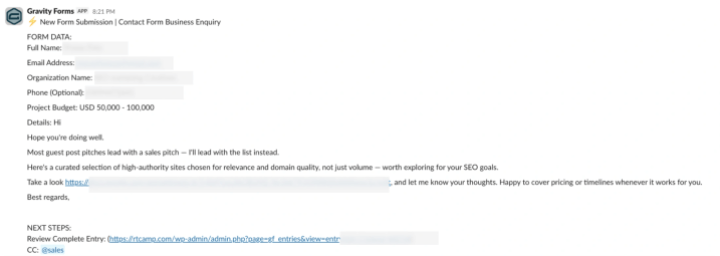
Every sales lead at rtCamp starts the same way: a form submission. These submissions land in a dedicated team channel with the prospect’s name, email, company, project budget, and requirement.
As submission volume grew, so did the noise. Alongside genuine prospects, the channel filled up with agency pitches, resumes, phishing scams, fake inquiries, and leads with inconsistent information. The sales team had to manually review every single submission before deciding where to invest their time.
This is a familiar problem for any growing business, and it is exactly the kind of problem our AI automation practice exists to solve. We saw an opportunity to apply that expertise internally, and built a system that now qualifies, researches, and summarizes every lead automatically.
Our approach: Automation that thinks before it acts
Rather than bolting AI onto an existing process, we designed the workflow around a simple principle: only spend AI effort where it earns its keep. Using n8n as the workflow orchestration layer, the system watches for genuine lead activity and ignores everything else. Only messages that match the expected pattern of a real form submission move forward for processing. This keeps the workflow focused on actual leads and avoids running AI models on unrelated chatter, which keeps the system fast and cost-efficient at scale.
That discipline knowing where to apply automation and where to hold back is the difference between an AI feature and a working AI system. n8n gives us the flexibility to connect the different steps, apply the right logic at the right point, and bring AI into the workflow only when it adds value.
Step 1: Qualifying every lead automatically
The first job of the system is qualification: deciding whether a submission deserves a human’s attention at all.
We built an AI agent that reviews each submission and classifies it as spam or relevant, along with a short reason for that decision. For this stage we use a lightweight AI model chosen specifically for high-volume, low-cost classification, since qualification runs on every single lead and needs to be fast and inexpensive.
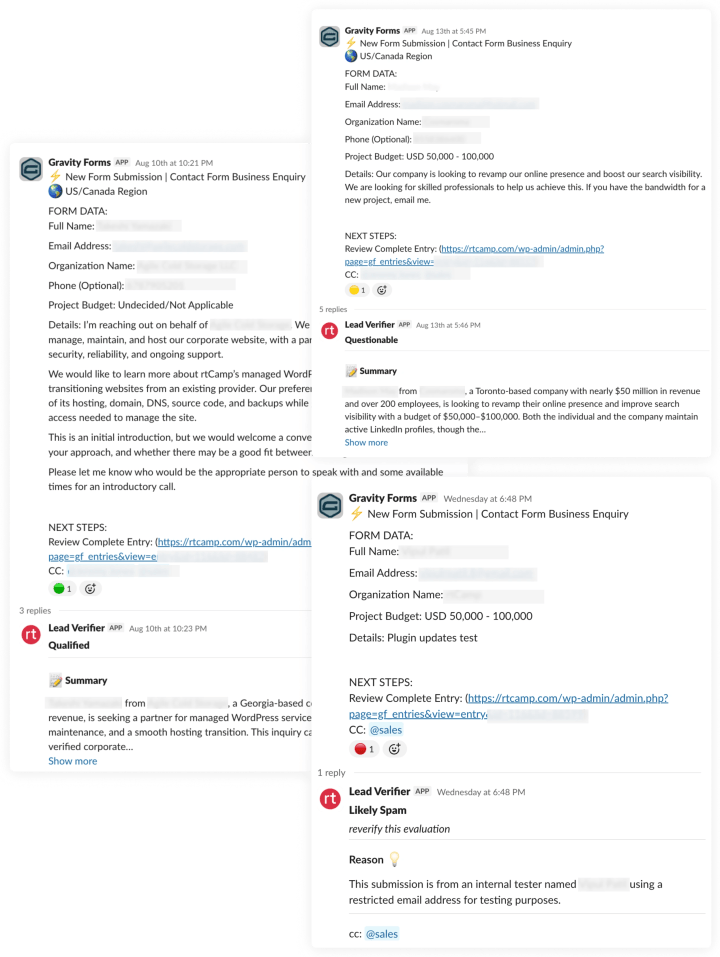
Agency pitches, resumes, promotional messages, crypto scams, and other irrelevant submissions get marked as spam. These leads receive a red indicator in the team channel along with a brief explanation, and the system stops further processing for that lead.
This is a deliberate design choice on our part: match the model to the task. Across this system, we draw on a mix of Google Gemini models, including Gemini 3.1 Flash Lite, Gemini 3.5 Flash, and Gemini 3.1 Pro, each assigned to the stage it handles best. Not every step in an automation needs the most powerful model available, and knowing which step does is part of the expertise we bring to every project.
Step 2: A three-level system for everything else
A genuine lead can still carry questionable information. A prospect may list a company name that differs from their email domain, use a personal email address, or submit incomplete details while still representing a real business need.
We handle these cases with a simple three-level system:
StatusWhat it means🟢 GreenRelevant lead with consistent information. Ready for immediate sales follow-up.🟡 YellowPotentially relevant lead that needs a closer look, such as a mismatched company domain or incomplete details.🔴 RedLikely spam or an irrelevant inquiry. The workflow stops here, and no further AI credits or sales time are spent.
This system gives the sales team an instant view of which leads deserve immediate attention, without anyone having to read through raw submission data.
Step 3: Turning a qualified lead into a researched prospect
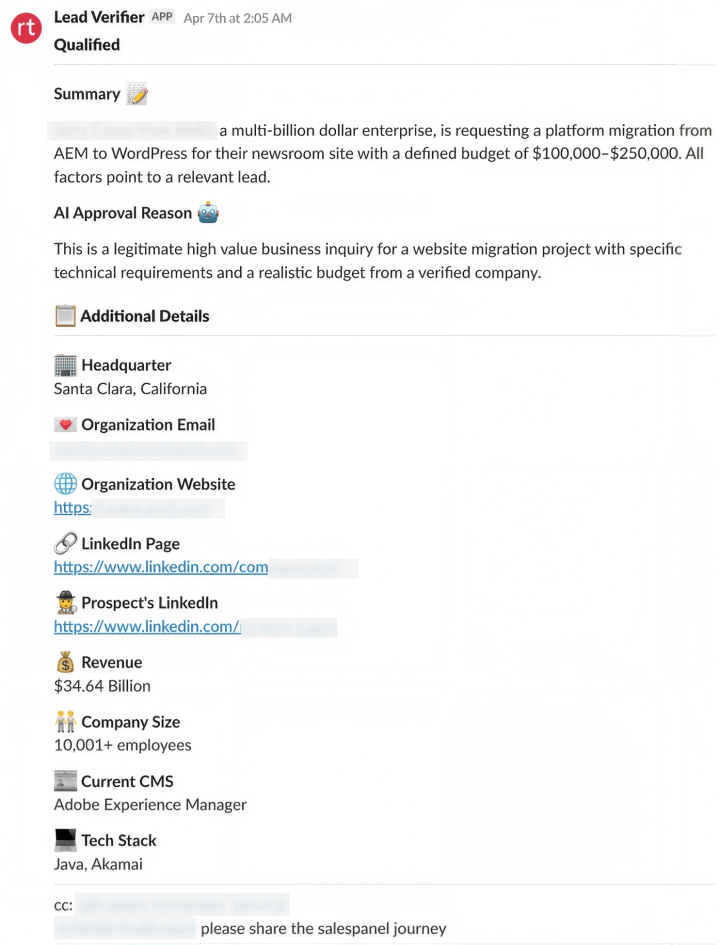
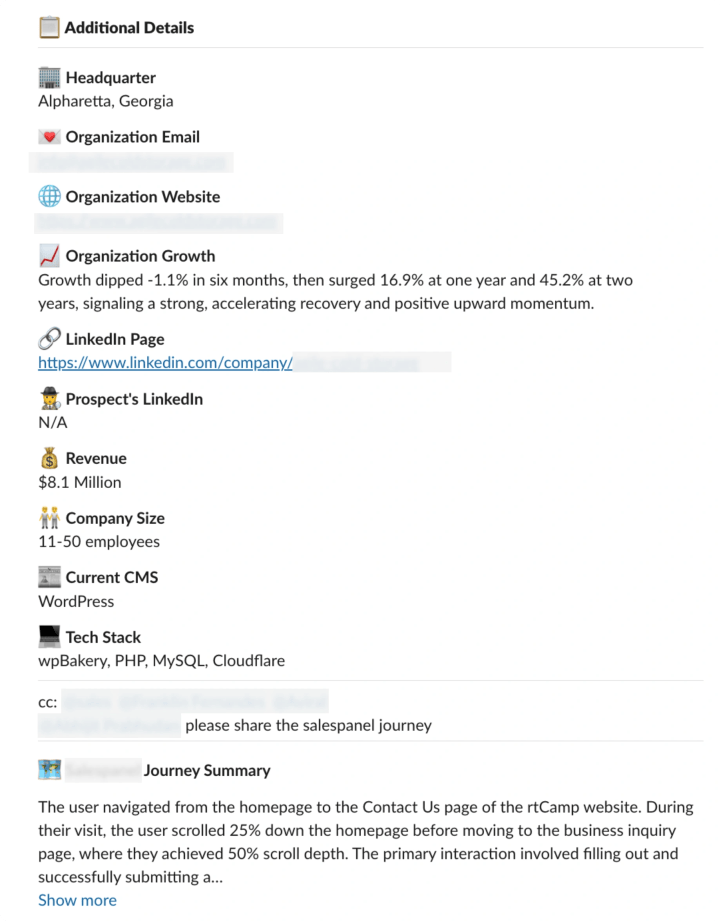
Qualification is only half the job. A qualified lead still needs research: the sales team wants the company website, LinkedIn profile, company size, revenue, headquarters, technology stack, and growth signals before they reach out.
We automated this research inside the same system, pulling from a small set of specialized web research and data enrichment tools alongside our AI models. The system identifies the organization’s email and website, researches the prospect’s LinkedIn profile, and gathers company details such as size, revenue, headquarters, and growth indicators.
Understanding the prospect’s technology stack
We also wanted visibility into the technology behind each prospect’s website, since it shapes how a sales conversation should be framed.
A website technology detection service identifies the CMS and related platforms powering the site, including the CMS, CRM, Hosting, etc that they are working with. This gives the sales team useful technical context before the first conversation.
Understanding the prospect’s journey
We also look at how each prospect reached us. A journey-tracking integration with our visitor identification tool uses the prospect’s email address to stitch their interactions with rtCamp’s website before they submitted the form.
Our AI models then turn that raw journey data into a short, readable summary. Instead of digging through interaction logs, the sales team gets a quick overview of what the prospect did before reaching out.
Step 4: One AI model isn’t always enough
A theme runs through every stage of this system: the right AI model for the right job.
Classification runs on a fast, low-cost model built for high volume. Research summarization and journey analysis lean on a stronger general-purpose model that handles nuance well. The final lead brief, the one the sales team actually reads, is generated by the most capable reasoning model, since this is the output that most directly shapes a sales conversation.
This is a pattern we use across all of our AI automation work. Treating automation as a single model doing one job is a common and costly mistake. Treating it as a pipeline, with each stage matched to the model best suited for it, is what makes a system fast, affordable, and genuinely useful in production.
Step 5: Everything delivered in one place
Once research is complete, the system generates a concise summary of the lead. The sales team receives the key information directly in the team channel, including:
- Lead qualification status (green, yellow, or red)
- Prospect and company details
- LinkedIn information
- Company size and revenue
- Headquarters and growth indicators
- Website technology and CMS
- Prospect journey summary
- AI-generated overall summary
There is no need to open multiple tools or manually research every new lead. Everything the sales team needs lives in a single thread.
The results: Saving hours of sales research every day
This system saves an estimated one hour of manual research per lead.
With about a 100+ form fills every month, roughly half of them spam, that translates to approximately 5 to 6 hours of research saved daily, or 100+ hours saved every month. More importantly, the sales team can now spend their time on conversations and opportunities instead of repetitive research.
What this says about our AI automation practice
What started as a simple problem with noisy Slack notifications became a full demonstration of how rtCamp approaches AI automation: understand the process first, automate only what earns its place, and match each step to the right tool and the right AI model rather than reaching for the biggest one by default.
With n8n providing the workflow orchestration layer, the system brings together automation, AI models, and specialized research without adding unnecessary complexity. The specific tools matter less than the thinking that ties them together. That thinking is what we bring to every automation engagement, whether the goal is qualifying sales leads, streamlining operations, or automating content workflows.
For us, this is what practical AI automation looks like: removing repetitive work from a process and putting useful information in front of the right people exactly when they need it.
Want an AI automation system built for your team?
This lead qualification workflow is one example of how rtCamp’s AI automation practice approaches a real business problem. Get in touch to talk through what a similar system could look like for your sales, operations, or content workflows.
The problem: A noisy channel full of sales leads
Our approach: Automation that thinks before it acts
Step 1: Qualifying every lead automatically
Step 2: A three-level system for everything else
Step 3: Turning a qualified lead into a researched prospect
Understanding the prospect's technology stack
Understanding the prospect's journey
Step 4: One AI model isn't always enough
Step 5: Everything delivered in one place
The results: Saving hours of sales research every day
What this says about our AI automation practice
Want an AI automation system built for your team?
On this page
AI Automation, AI Sales Workflow, automated lead qualification
Credits

Rishit Gupta
Author
Rishit Gupta
Author
Rishit works as a Growth Engineer at rtCamp. He uses his engineering skills to help build solutions for marketing and sales teams to work more efficiently. He has over 3 years of experience as a fu…

Aviral Mittal
Editor
Aviral Mittal
Editor
Aviral Mittal is the Chief Marketing Officer at rtCamp, where he established and leads the marketing function, building and growing a team of 20+ specialists across content, SEO, design, and growth…
Related articles
-
Behind the table Takeaways from WordCamp’s “Core AI Prompt Bar” with David Levine
Events
-
A year of reinvention as we turn 17
News
Comments
Leave a Reply Cancel reply
Name*
Email*
Comment*
Submit
Δ