Score the agency in front of you
Fifteen questions to ask any agency pitching for your CMS migration, each with a weak and a strong answer, so you know what to listen for. Score as you go during the call, and the scorecard flags the weak answers to follow up on.
Score the agency in front of you
Fifteen questions to ask any agency pitching for your CMS migration, each with a weak and a strong answer, so you know what to listen for. Score as you go during the call, and the scorecard flags the weak answers to follow up on.
0 of 15 scored
— / 100 pts
— / 100 pts
0 of 15 scored
- Who are you scoring?
- Engagement and commercials Section 1 0 of 3
- Platform migration Section 2 0 of 3
- Performance, security and reliability Section 3 0 of 3
- AI readiness Section 4 0 of 3
- Credibility and team Section 5 0 of 3
Who are you scoring?
This is saved with your answers, so you can tell the agencies you score apart.
Agency being evaluated
Scored by
Date of the call
Project in scope
Section 1
Engagement and commercials
3 questions
Question 1 What exactly do we receive from the free discovery, and can we use it if we do not proceed with you?
Weak
“You get a proposal at the end of the workshop.”
Strong
You leave with a platform architecture assessment, a phased roadmap with budget ranges, and an internal business case you can take to your committee. It is yours to keep and act on, with us, with another team, or in-house.
Weak Vague Solid Strong
Notes
Question 2 How does pricing work?
Weak
“We’ll scope after initial conversations. Pricing can vary based on complexity discovered mid-project.”
Strong
We keep pricing transparent. During our complimentary discovery, we scope as much as possible and give you a fixed quote or a clear range with assumptions spelled out. Even on time-and-materials work, every task or module is pre-estimated before development starts, so there are no surprises.
Weak Vague Solid Strong
Notes
Question 3 Who owns the code, content, and infrastructure when the engagement ends?
Weak
“We retain the custom code, and you license it while you work with us.”
Strong
You own all of it. WordPress core is open source; there is no proprietary layer to license, and you can move your host or your agency without a rebuild. Ownership is the point of building on WordPress rather than a closed DXP.
Weak Vague Solid Strong
Notes
Section 2
Platform migration
3 questions
Question 4 How do you approach multisite or multi-brand architecture?
Weak
“We build each site separately and connect them where needed.”
Strong
A thorough review of your existing sites and overarching goals is always step one. From there, we derive the most efficient, scalable and secure approach for the organization. Often we recommend our OnePress framework, which standardizes 70–80% of the shared multisite codebase. Each brand gets the remaining 20–30% built to its unique identity and requirements.
Weak Vague Solid Strong
Notes
Question 5 How do you protect SEO rankings during migration?
Weak
“We follow SEO best practices.”
Strong
Field-by-field metadata migration (title tags, meta descriptions, OG tags, structured data). Crawl simulation before launch. CWV baseline established pre-migration with post-launch benchmarking.
Weak Vague Solid Strong
Notes
Question 6 Does the live site stay live throughout the migration?
Weak
“There will be a maintenance window.”
Strong
New platform built in parallel. Incremental content migration with editorial operations continuing on the existing platform until switchover. Zero downtime.
Weak Vague Solid Strong
Notes
Section 3
Performance, security and reliability
3 questions
Question 7 How do you govern plugins and third-party code?
Weak
“We install the plugins the project needs and keep them updated.”
Strong
Plugin sprawl is the most common cause of enterprise WordPress performance and security regressions. Nothing gets installed, updated, or deprecated without engineering sign-off, and no update ships without regression testing. You get a governed plugin review cadence, not an open install policy.
Weak Vague Solid Strong
Notes
Question 8 What performance and Core Web Vitals targets do you commit to, and how do you measure them?
Weak
“The new site will be faster than the old one.”
Strong
A Core Web Vitals baseline is captured before the build and benchmarked after launch, so the improvement is measured rather than asserted. Recent results: Pasqal moved from 66 to 90, VinSolutions improved CWV by 48 percent, and FleetNet America doubled its scores after migrating off Drupal.
Weak Vague Solid Strong
Notes
Question 9 What happens when something breaks in production?
Weak
“Open a ticket and we will look at it during business hours.”
Strong
An emergency response engages within hours, across time zones. Most enterprise WordPress failures trace to one of five root causes (a failed plugin update, a hosting change, a breach from ungoverned plugin access, a load-driven collapse, or a botched deployment), and each incident closes with a root cause analysis and a remediation roadmap.
Weak Vague Solid Strong
Notes
Section 4
AI readiness
3 questions
Question 10 What is your approach to AI-led personalization?
Weak
“Personalization is available through a third-party integration.”
Strong
We take an owned-infrastructure approach to AI: personalization is built on the platform itself, so you are not dependent on DXP add-ons such as Sitecore Personalize or Adobe Target, which can carry 7-figure costs.
Weak Vague Solid Strong
Notes
Question 11 What is your process for assessing a platform’s current AI readiness?
Weak
“We evaluate AI needs during the discovery phase.”
Strong
AI Readiness Assessment covering all five dimensions: content discoverability on LLMs, AI-assisted editorial, AI-led personalization, platform integration capability, and AI-accelerated development. Delivered as a scored gap analysis before any build begins. Entry point: 20-hour free AI Readiness Quickscan.
Weak Vague Solid Strong
Notes
Question 12 Are your engineers WordPress core contributors, and why does that matter for us?
Weak
“Our developers are experienced WordPress users.”
Strong
rtCamp engineers contribute to and maintain parts of WordPress core, including the Abilities API that underpins how AI tools talk to WordPress. You get the team building the platform’s future, which means earlier access to new capabilities and fewer custom workarounds.
Weak Vague Solid Strong
Notes
Section 5
Credibility and team
3 questions
Question 13 What WordPress-specific credentials does your team hold?
Weak
“Our developers have built hundreds of WordPress sites.”
Strong
WordPress VIP Gold Partner. Automattic Premier Partner. Active WordPress core contributors. 500+ enterprise engagements. 300+ migrations. rtCamp is also SOC 2 compliant and ISO 27001 certified.
Weak Vague Solid Strong
Notes
Question 14 Can you show references from organizations with similar scale and complexity?
Weak
“We can share a few client names.”
Strong
Named references with specific outcomes: Cox Automotive (8 brands, 2× CWV), Al Jazeera (headless multiplatform), Penske Media (7+ years, 1 → 10+ engineers), Videojet (28 sites, 12,000 pages, 22 languages).
Weak Vague Solid Strong
Notes
Question 15 Who does the work day to day, and how senior are they?
Weak
“We assign available developers from our team.”
Strong
Senior WordPress engineers do the work. rtCamp hires 60 of every 60,000 applicants, and each engineer completes around six months of enterprise training and live project experience before touching client code. Because the rate is fixed, you are not paying more to have the senior person on the hard problem.
Weak Vague Solid Strong
Notes
Back
ContinueSee my results
Your scorecard
What this agency scored
Score every question above. The total, the category breakdown, and the list of weak answers unlock here once nothing is left blank.
/ 100 pts
This agency answered with process, deliverables, and named proof across nearly every category. Shortlist them and spend your remaining diligence on references.
Solid in most areas, thin in a few. Go back on the low-scoring questions and ask for specifics before you decide. The gaps are usually where the project risk sits.
Plausible on the surface, but too many answers were reassurance rather than process. Ask for a written scope of how they would handle your two lowest-scoring categories.
Most answers described intent rather than method. On a migration of any complexity, this pattern predicts scope growth and post-launch surprises.
Category breakdown
Engagement and commercials
/ ·
Platform migration
/ ·
Performance, security and reliability
/ ·
AI readiness
/ ·
Credibility and team
/ ·
Answers to push back on
Every question you marked Weak or Vague. These are the places to go back and ask for specifics before you shortlist.
Nothing was marked Weak or Vague. Every answer carried some substance, so verify the strongest claims against named references.
Next step
Ask us the same 15 questions
This scorecard was built from what separates a strong migration partner from a plausible one. Put rtCamp through it: book a free 30-minute call, score us live, and compare the scorecard against whoever else is pitching.
Related resources
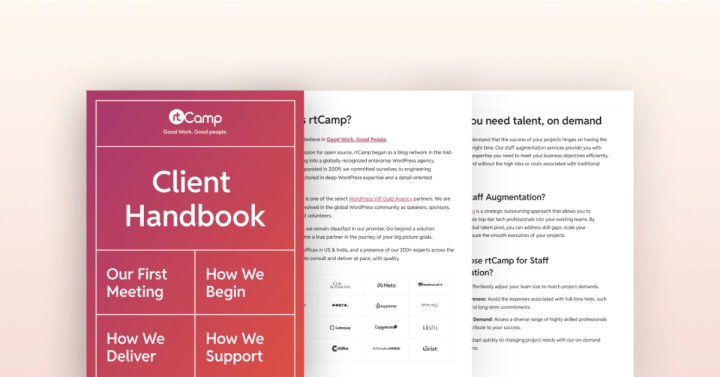
Handbook
How rtCamp works with clients, from the first meeting to delivery and long-term support

Resource
Why WordPress is a proven platform for enterprise digital ecosystems
Scoring another agency?
Reset the scorecard
Reset the scorecard? All scores, notes, and the agency details will be cleared.
Back
Clear my answers
Δ
Full Name(Required)
Organization Name(Required)
Work Email(Required)
Email me a copy of my scorecard
Email me a copy of my scorecard
By submitting this form, you acknowledge rtCamp’s Privacy Policy.
BOOK MY CALL